TL;DR
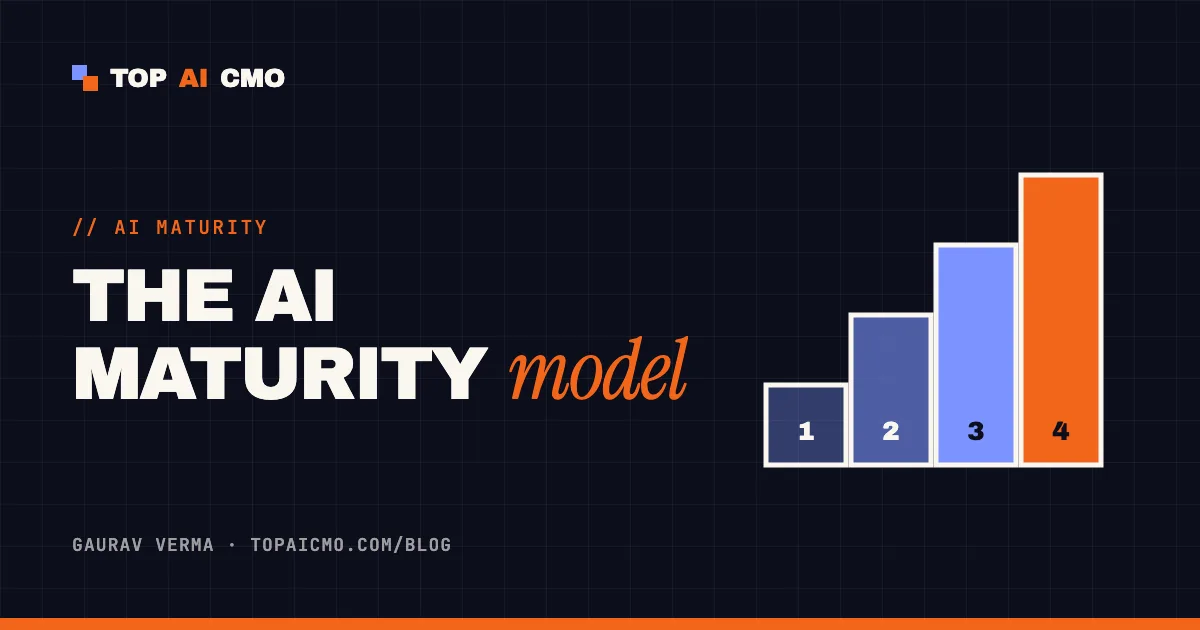
An AI maturity model for marketing places your team on four stages, from scattered personal AI use to a connected marketing system that keeps learning. The four stages are AI Experimentation, AI-Assisted Marketing, AI Workflow Operations and the AI-Native Marketing System. Most marketing teams sit between Stage 1 and Stage 2 and believe they are at Stage 3. The honest measure of maturity is who owns each workflow, because tool count only tracks what you bought. Score each function separately on evidence, since one blended score hides the function that is still at Stage 1. Moving from Stage 1 to Stage 2 takes about a month, and Stage 2 to Stage 3 takes two to three quarters.
Key takeaways
- Place maturity per function, because content and paid rarely sit at the same stage.
- A workflow that lives in one person’s head leaves the day that person does.
- Any score above two on the maturity scale needs evidence, or it is opinion wearing a number.
- Track autonomy mix, review hours, gate migrations, first-pass rate, extensions and retirements instead of logins.
- Enterprise models from MIT CISR, MITRE and Microsoft suit company roadmaps, while marketing needs a workflow-level next move.
- Nobody builds Stage 4 directly, since it comes from running Stage 3 honestly for long enough.
Why Most AI Maturity Models Miss the Marketing Team
Most marketing teams I talk to bought their AI seats a year ago. Ask five people how AI gets used day to day, and you hear five different answers, none of them tied to revenue.
An AI maturity model is supposed to settle that by telling you where you actually stand. Most of the popular ones were built for IT or media buying, so they grade data platforms, model counts and budgets.
Marketing has a different problem. The work lives in people’s habits, and a tool bolted onto a habit moves nobody up a level. The real question is where your workflows live and who owns them.
What Is an AI Maturity Model for Marketing?
An AI maturity model for marketing is a staged framework for one question. How far has your team moved from scattered personal AI use to owned, measured workflows? Its job is honest self-placement, function by function, so you know which move comes next.
Enterprise versions grade pillars such as strategy, data, governance and culture across the company. A classic marketing maturity model grades channels, data and the martech stack.
The version I use grades whether a person or the organization owns each piece of work. It is the AI-Native Marketing Maturity Model, the first of eight frameworks in my book, The Agentic AI Marketing Leader Playbook.
Three terms get mixed up here. Adoption counts who uses AI, readiness asks whether you are prepared to start a specific initiative, and maturity asks how well the work already running is owned, measured and connected.
A team can score high on adoption and still sit at Stage 1. For a quick first read, the free AI maturity check places your team on the four stages in about three minutes.
What Are the Four AI Maturity Levels in Marketing?
The four AI maturity levels in marketing are AI Experimentation, AI-Assisted Marketing, AI Workflow Operations and the AI-Native Marketing System. Each level carries one leadership question, and the honest answer tells you what to build next.
Stage 1: AI Experimentation
People use AI on their own initiative, with no shared approach, no ownership and no measurement. One writer polishes drafts with ChatGPT while the teammate beside them refuses to touch it. The leadership question is what people are actually doing with AI right now, and most leaders who think they know are wrong.
Stage 2: AI-Assisted Marketing
AI helps with existing work such as drafts, research and reporting, but humans still run every process end to end. In a content team, AI writes the draft and a person still owns the brief, the edit, the upload and the promotion. The question is where AI can save real hours instead of theoretical ones.
Stage 3: AI Workflow Operations
Repeatable workflows exist as designed systems, each with a named owner and a real baseline. Lead scoring runs on a schedule, and content refresh starts because a system flagged a stale page. The question becomes which processes can now run without one person’s daily attention.
Stage 4: AI-Native Marketing System
Workflows share knowledge, so the keywords one workflow mines show up in the next content brief. Sales complaints about lead quality reach the scoring rules without a meeting, and humans spend their time on judgment calls and exceptions. The question is how marketing keeps learning instead of decaying after launch.
Most teams I have worked with, my own included at various points, sit between Stage 1 and Stage 2 when they answer honestly. Most leaders place themselves one stage higher on the AI maturity model than the evidence supports.
The AI Maturity Model for Marketing, Level by Level
The fastest way to read your level is to look at an ordinary Tuesday, then name the bottleneck that keeps you there. Each level has one move that gets you to the next, and skipping that move is the most common reason AI programs stall.
| Level | What you see on a normal week | The bottleneck | The one move to the next level |
|---|---|---|---|
| Stage 1. AI Experimentation | Personal ChatGPT habits, private prompts, nobody tracking usage or results | Nobody can see what is happening, so nothing can be shared or measured | Survey what people already do with AI and share what works. Plan on about a month. |
| Stage 2. AI-Assisted Marketing | AI drafts, humans run the brief, edit, upload and promotion. Pilots stall after the demo. Review hours stay high and flat. | The old workflow with AI bolted on, still living in one person’s habits | Redesign one high-frequency workflow as an owned system with a gate, a baseline and a named owner. Budget two to three quarters. |
| Stage 3. AI Workflow Operations | Workflows run on a schedule, each with an owner and a baseline. The first gate migration and the first retirement happen. | Each workflow keeps its own copy of the facts and runs alone | Point every workflow at one shared knowledge base, then operate Stage 3 honestly each quarter until the connections compound. |
| Stage 4. AI-Native Marketing System | Workflows feed each other, agents act within governed boundaries, review time goes to judgment calls | Decay, as markets shift and nobody retires what stopped working | Re-score every quarter, retire workflows as a routine decision, and keep a human reviewer on everything customer-facing. |
Read the table one function at a time. The move out of Stage 2 is the expensive one, because you stop asking how AI can do a step and start asking whether the step needs to exist.
What Does an AI Maturity Framework Measure in Marketing?
An AI maturity framework for marketing should measure four things in every workflow, which are ownership, baseline, gate and connection. Enterprise pillars still matter, but each one needs a marketing translation first.
- Ownership. A named owner, plus a backup who could run the workflow from its runbook.
- Baseline. The number measured before launch, so any improvement has something to beat.
- Gate. A written condition with a named reviewer and hard limits on what AI can publish. My post on human in the loop AI for marketing covers how gates move.
- Connection. Whether the workflow reads from one shared knowledge base or keeps a private copy of the facts.
The crosswalk below translates public pillar names from MITRE and Microsoft into evidence a marketing team can show.
| Enterprise pillar | Where it appears | Marketing evidence to look for |
|---|---|---|
| Strategy | MITRE Strategy and Resources, Microsoft AI strategy and experience | A ranked list of workflows to build, each with an owner and a target metric |
| Data | MITRE Data, Microsoft Technology and data | Scheduled CRM hygiene, and one knowledge base every workflow loads |
| Governance | MITRE Ethical, Equitable, and Responsible Use, Microsoft AI governance and security | Written gates, named reviewers, and a human on customer-facing output |
| Organization and culture | MITRE Organization, Microsoft Organization and culture | A backup owner per workflow, and workflows proposed without being asked |
| Value and performance | MITRE Performance and Application, Microsoft Business strategy | Baselines before launch and the six progress measures, re-scored quarterly |
How Do You Score Your Team on the AI Maturity Model?
Score each marketing function separately, on evidence, and keep the scores apart. One blended number hides the function still at Stage 1, which is usually where the next build belongs.
Microsoft’s guidance on using its agentic AI adoption maturity model warns against creating a single overall score. It also tells teams to be evidence-based, not aspirational, and to expect uneven maturity across pillars.
In the book I anchor a one-to-five scale. One is undocumented and ad hoc, two is repeatable by individuals, and three is documented and consistently run. Four is measured and actively managed, and five is instrumented, governed and continuously improving.
Any score above two needs evidence, such as a runbook, a baseline or a gate log. Without it, the scoring turns into management opinion wearing a number.
In the workshop format from the book, each leader places their own function on the four stages, on paper, before anyone discusses it. Placing first and debating second keeps the loudest voice from setting everyone’s stage.
Why Do Workflows Live in People Instead of the Organization?
Workflows live in people because most marketing work was never designed as a system. Ask how a lead gets qualified or how a blog post gets published, and you usually hear a name instead of a process.
Mapping how work actually happens has turned up the same two findings in every organization where I have done it. At least one significant workflow lived entirely inside one person’s habits, unknown to their manager, and at least one documented process had not matched reality in over a year.
I learned the cost of person-embedded work the hard way. A set of my working automation scripts survived a destructive cleanup only because they sat in a folder the operation never touched, so luck protected them and the design did not.
That is why the AI maturity model I use asks who owns the work before it asks what tools you run. The company that owns its workflows can change AI vendors over a weekend, while the company whose workflows live in people can lose a capability to one resignation.
Why Is Tool Count the Wrong Measure of AI Maturity?
Tool count measures purchasing, while an AI maturity model should measure ownership. A team with twelve AI subscriptions and no owned workflows is still at Stage 1 or 2.
Microsoft’s agentic AI adoption maturity model describes its lowest level in the same terms. At Level 100, capabilities are inconsistent, siloed and dependent on individuals rather than repeatable practices.
So measure what only moves when the organization gets better at AI. These are the six I track at every level of the AI maturity model.
- Autonomy mix. The split of manual, AI-assisted and autonomous work across the portfolio, drifting toward autonomous each quarter without the gates catching more errors.
- Review hours per unit of output. Falling hours with a steady first-pass rate is earned trust. Falling hours with a falling first-pass rate is corner-cutting.
- Gate migrations. Workflows that earned a move from human-reviewed to human-monitored this quarter, each one a documented decision.
- First-pass rate. The share of output that clears the quality gate without rework, which no one can flatter.
- Unprompted extensions. Workflows the team proposed without being asked, the one number on this list that cannot be faked.
- Retirements. Workflows you switched off because they stopped earning their place.
Two readings deserve a warning. Zero unprompted extensions for two straight quarters says adoption is still compliance, and zero retirements says the portfolio is growing on autopilot.
Login counts and adoption percentages answer none of these questions, so I keep them out of board decks.
How Does the Gartner AI Maturity Model Compare With Other Frameworks?
Enterprise AI maturity models grade the whole organization across pillars, so a marketing team gets a useful frame but no marketing-specific next move. Use them for the company roadmap and a workflow-level model for marketing.
If you came here for the Gartner AI maturity model, its AI maturity model and roadmap toolkit page is the place to start. The full model sits in Gartner’s client research, so I won’t restate its levels secondhand, and the table compares frameworks published openly at the source.
| Framework | Levels | What it measures | Best used for |
|---|---|---|---|
| MIT CISR Enterprise AI Maturity Model | 4 stages, Experiment and Prepare to Become AI Future Ready | Enterprise AI capability, linked to financial performance across 721 companies | The board-level case for scaling AI |
| MITRE AI Maturity Model | 5 levels, Initial, Adopted, Defined, Managed and Optimized | Six pillars and 20 dimensions | Programs that need a detailed rubric |
| Microsoft Agentic AI Adoption Maturity Model | 5 levels, Level 100 Initial to Level 500 Efficient | Five capability pillars for scaling AI agents | Putting agents into production |
| WPP Media AI Marketing Maturity Model | 6 vectors, no public stage names | Marketing analytics, digital analytics, commerce, creative AI, audiences and bidding | Media and advertising readiness |
| CMO Alliance Readiness Vectors | 4 vectors, each scored 20% to 100% | Organizational capacity, how much AI moves the business model, change velocity and competitive necessity | Deciding how fast to move |
| AI-Native Marketing Maturity Model | 4 stages, AI Experimentation to AI-Native Marketing System | Ownership, baselines, gates and connection, per function | Choosing the next workflow to build |
MIT CISR’s enterprise AI maturity model research from December 2024 makes the case for climbing. Companies in its first two stages performed below their industry average financially, those in stages three and four were well above it, and only 7 percent reached the top stage.
The MITRE AI Maturity Model adds a point worth borrowing, which is that not every organization needs level 5 on every pillar. WPP Media’s AI marketing maturity model sits closest to marketing, though its vectors describe media capabilities rather than everyday content and pipeline work.
Why Do Marketing AI Programs Stall at Stage 2?
Marketing AI programs stall at Stage 2 because the old workflow stays in place with AI bolted on. The pilot proves the tool works, and nobody owns turning it into a system.
James Shaw at CMO Alliance cites the firm’s 2026 research showing 53 percent of marketing leaders running AI pilots. Microsoft’s model describes the same level in its process pillar, where pilots improve single workflow steps and nobody redesigns the process end to end.
The workshop format in the book asks early what the room already tried, what stalled and why. The answers become a stalled-pilot list, and four mistakes tend to sit behind it.
- Counting adoption as maturity. Seats and logins prove a purchase, not an owned process.
- Leaving the pilot without an owner. Nobody is accountable for week ten.
- Skipping the baseline. Nobody can prove the pilot earned a second quarter.
- Trusting usage over outcomes. A workflow can run daily while the people downstream ignore it.
That last one happened on my own team. A lead-scoring workflow ran for months while sales drifted back to the old method, because a lead it rated highly was plainly wrong for us and a good one was buried.
A workflow stuck at AI drafts while humans do everything else for a year is not broken. It is telling you honestly that it is early.
How Do You Move Up the AI Maturity Curve in Marketing?
You move up the AI maturity curve one function and one workflow at a time. Place each function honestly, make current usage visible, then redesign one high-frequency workflow as an owned system before you start the next.
- Make the invisible visible. Survey what people already do with AI, share what works, and stop treating experimentation as private.
- Pick by frequency times time per instance. Rebuild first the workflow that runs often and eats hours, however unexciting it looks.
- Redesign before you automate. Bolting AI onto a broken process gets you to the breakage faster and adds a token bill.
- Give it an owner, a baseline and a gate. Write the gate as a condition that either opens or stays shut.
- Version it like a product. A version number, a changelog and a backup owner let a junior marketer run it from the runbook.
The first month should produce a scored workflow inventory, a maturity placement per function and a shortlist of first builds. The second month goes to foundations, starting with one owned knowledge base, because every later workflow reads from it.
Schedule the weekly review, the monthly performance pass and the quarterly portfolio review before there is anything to review.
If you are still deciding what marketing should use AI for at all, start with my post on AI marketing strategy.
My own library runs at roughly three dozen versioned skills, each with a named owner and a changelog, and the marketing systems I run today show several in production. My post on Claude skills for marketing shows how one gets written.
At an HR tech SaaS company where I ran marketing this way, AI-sourced sessions grew from 335 to 3,200 a month. The HR tech results page has the rest.
Which Workflows Should You Build First at Each AI Maturity Level?
Build the workflows that make your next level possible. The check built on this AI maturity model recommends three per stage, and they follow the same logic I use with leadership teams.
- Stage 1. An organization knowledge base and marketing asset inventory, content quality scoring, and new keyword discovery. These make the work visible and give every later workflow one shared set of facts.
- Stage 2. An end-to-end blog production workflow, content refresh prioritization, and CRM hygiene monitoring. Each runs often, is easy to baseline, and produces cleaner data as an output.
- Stage 3. AI search visibility tracking with an AEO and GEO audit, lead scoring and enrichment, and ABM account intelligence. These start handing data to each other.
- Stage 4. Closed-won expansion, a win-back workflow, and performance monitoring across paid. These depend on the shared knowledge the earlier stages built.
CRM hygiene sits at Stage 2 on purpose, because the cleaning is the automating. My CRM watchdog runs daily and unattended, while my blog pipeline still waits for a human to approve every post.
By Stage 4 some of these run as agents within set boundaries. My post on AI marketing agents shows the ten I run in production and where each gate sits.
Should Every Marketing Team Aim for Stage 4?
Every team should aim for its honest next stage, function by function, and let Stage 4 arrive on its own. Treating Stage 4 as a target usually produces a slide instead of a system.
James Shaw at CMO Alliance argues that the standard four-stage model describes current activity and cannot tell a CMO how fast to move. I agree with half of that, which is why every stage in my table carries a bottleneck and a next move.
Small teams often move faster, because every vacation proves the problem. Want an outside read on your placement? The AI marketing operating system audit I run ends with a maturity score for each function, with the evidence behind it.
A Monday Ritual to Climb One AI Maturity Level
Call it the Three-Answer Muster. On Monday, pick one marketing function and ask three people, separately, how one task gets done from start to finish.
Write the three answers side by side and place that function on the four stages. Then score the function on the four levels with its owner. Pick one workflow to rebuild, and give it an owner, a baseline and a gate before Friday.
Repeat with the next function the following Monday, and re-score all of them each quarter. Motion and output are different things, and this ritual shows you which one you have.
Sources
- Gartner: AI Maturity Model and AI Roadmap Toolkit
- Microsoft Learn: Introduction to the agentic AI adoption maturity model
- Microsoft Learn: How to use the agentic AI adoption maturity model
- MITRE: The MITRE AI Maturity Model
- MIT CISR: Press release on the enterprise AI maturity model (December 2024)
- CMO Alliance: Why the AI maturity model is failing CMOs (James Shaw, May 2026)
- WPP Media: New maturity model helps marketers chart their course to AI transformation

Written by
Gaurav Verma is a B2B CMO and AI marketing advisor, and the author of The Agentic AI Marketing Leader Playbook. He builds AI-native marketing engines and helps B2B brands get cited in AI answers. See the results.